
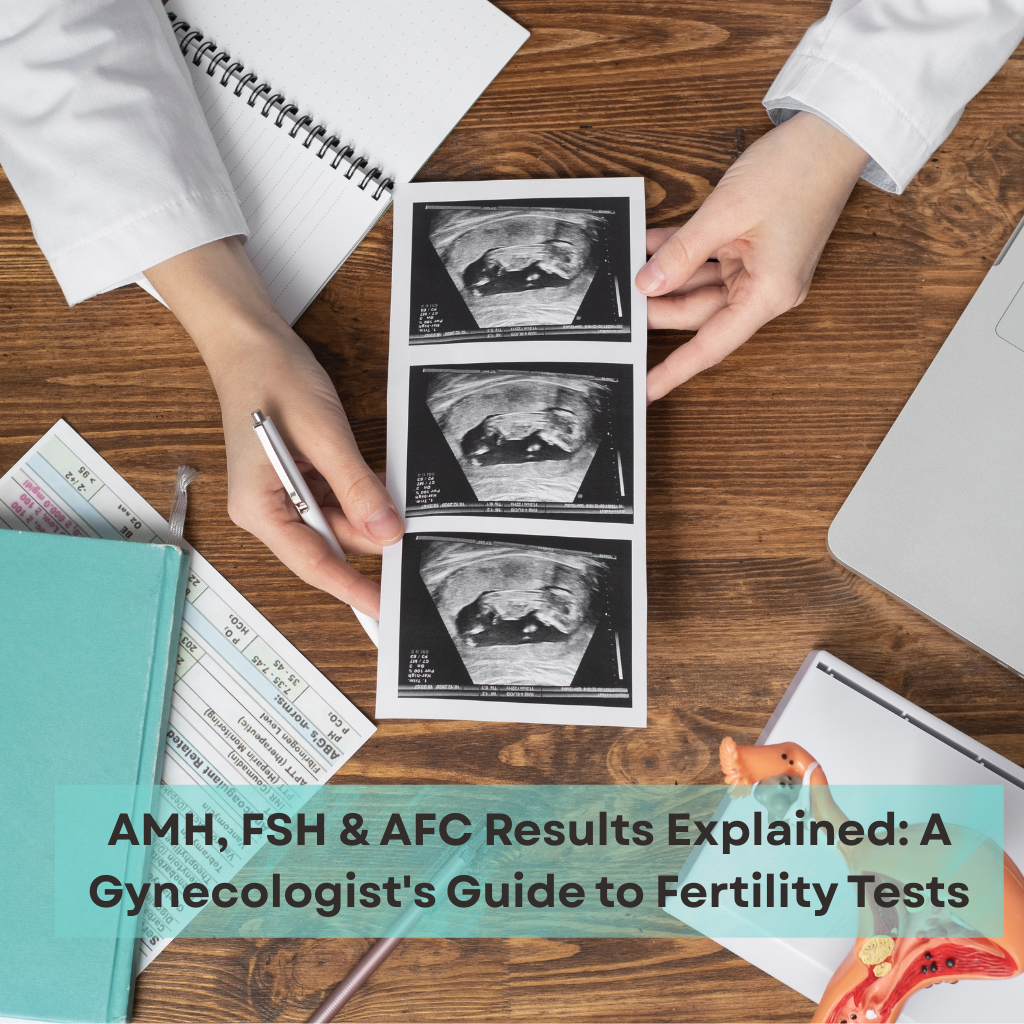
When you’re planning a pregnancy, fertility tests can sometimes leave you with more questions than answers. You may hear terms such as AMH, FSH and AFC during a consultation and wonder what they actually mean.
Does a low AMH mean you cannot get pregnant? Is a high FSH always a sign of poor fertility? And what exactly does an AFC test show?
The truth is that no single fertility test can tell you whether you will or will not become pregnant. AMH, FSH and AFC provide different information about ovarian reserve and ovarian function. Your age, menstrual history, medical background and pregnancy plans are equally important when interpreting the results.
What Do AMH, FSH, and AFC Mean for Female Fertility?
AMH stands for anti-Müllerian hormone. It is produced by small follicles in the ovaries and is commonly used as a marker of ovarian reserve.
FSH, or follicle-stimulating hormone, is produced by the pituitary gland. It plays an important role in stimulating the ovaries and supporting follicle development.
AFC stands for antral follicle count. It is measured through an ultrasound and refers to the number of small antral follicles visible in both ovaries.
In simple terms:
- AMH gives an indication of the available follicle pool.
- FSH provides information about the hormonal signals involved in ovarian function.
- AFC allows the doctor to see and count small follicles on an ultrasound.
AMH and AFC are currently among the more sensitive markers used to assess ovarian reserve. However, these tests are not a measure of egg quality and cannot independently predict natural pregnancy.
At Womanhood, we do not simply look at a test result and proceed with treatment. We first take the time to understand your body, menstrual health, medical history and fertility goals so that any further assessment or treatment is recommended based on your individual needs.
What Do Fertility Testing Results Measure?
A fertility assessment looks at several factors rather than relying on one number. Depending on your situation, fertility testing may help your doctor understand:
- Ovarian reserve
These tests provide an estimate of the number of eggs or follicles remaining in the ovaries. Ovarian reserve generally declines with age, although the rate of decline varies between women. - Follicle development
AFC allows the doctor to see the small follicles present in the ovaries during an ultrasound examination. - Ovarian response to fertility medication
AMH and AFC can help estimate how the ovaries may respond to stimulation, particularly when fertility treatment such as IVF is being considered. - Hormonal signals affecting ovarian function
An FSH test, particularly when performed during the early part of the menstrual cycle, can provide additional information about ovarian function. - Fertility treatment planning
The results can help your doctor decide whether additional evaluation is needed and, when treatment is appropriate, help plan the approach.
One important point: ovarian reserve testing does not tell you whether you will definitely conceive naturally. A lower ovarian reserve does not automatically mean infertility, and a reassuring result does not guarantee pregnancy.
AMH, FSH and AFC Ranges: What Do Fertility Test Results Mean?
Understanding AMH, FSH and AFC results is not as simple as checking whether a number falls within a particular range. Your age, the timing of the test, laboratory reference values and overall reproductive health all play a role in how the results are interpreted.
AMH Levels
- Around 1–3.5 ng/mL: This range has commonly been used as a reference in fertility studies, but it should not be considered a universal “normal” range.
- Below 1 ng/mL: May indicate a lower ovarian reserve and should be interpreted alongside age and other findings.
- Very low AMH: May suggest diminished ovarian reserve, but it does not mean pregnancy is impossible.
- Higher AMH: Can be associated with a larger follicle pool and may also occur in women with PCOS.
AMH is considered a relatively stable marker of ovarian reserve and can generally be measured at different points in the menstrual cycle, although factors such as hormonal contraceptive use may influence the result. But can you get pregnant with low AMH levels? Yes, a low AMH does not mean pregnancy is impossible; it mainly provides information about ovarian reserve and should be interpreted alongside your age, overall fertility and other test results.
FSH Levels
- Below 10 IU/L: Often considered reassuring when measured during the early follicular phase, although the laboratory reference range should also be considered.
- 10 IU/L or above: May raise concern about reduced ovarian reserve, particularly when supported by other findings.
- Higher FSH: Can be associated with diminished ovarian reserve, but FSH can fluctuate between menstrual cycles.
- Timing matters: FSH is generally measured during the early follicular phase, usually around cycle days 2–4.
A single FSH result should therefore not be used to make a conclusion about your fertility.
AFC Results
- Around 10–20 follicles: May be considered a reassuring count in some fertility settings, but there is no single AFC number that applies equally to every woman.
- Lower AFC: May indicate a smaller number of recruitable follicles.
- Higher AFC: May indicate a larger follicle pool and can also be seen in women with PCOS.
- Very low AFC: May suggest diminished ovarian reserve and can be useful when planning fertility treatment.
AFC is usually assessed through transvaginal ultrasound during the early follicular phase. It is the total number of small antral follicles seen in both ovaries.
So, instead of asking only, “Is my result normal?”, a better question is: “What does this result mean for me?”
When Should You Consider Fertility Testing?
Not every woman needs immediate ovarian-reserve testing.
A fertility test for women may be considered when:
- You have been trying to conceive without success.
- Your periods are irregular or absent.
- You have a history of ovarian surgery or conditions that may affect ovarian function.
- You have concerns about your reproductive timeline.
- You are considering fertility treatment.
- You are planning pregnancy and want to discuss your reproductive health.
If you are simply curious about your AMH or ovarian reserve, it is worth having a consultation before ordering multiple tests. It can also be helpful to understand the common signs of good fertility in women, such as regular menstrual cycles and consistent ovulation. However, these signs alone cannot confirm fertility, and the right test is the one that answers a specific question about your reproductive health.
A Gynaecologist’s Tips for Fertility & Family Planning
1. Don’t Judge Your Fertility by One Number
A low AMH or higher FSH result can understandably cause anxiety, but it does not automatically mean that pregnancy is impossible. These tests mainly provide information about ovarian reserve and should be considered alongside age, menstrual history and other fertility factors.
2. Get the Right Test at the Right Time
Not every woman needs every fertility test. FSH is generally assessed during the early days of the menstrual cycle, while AMH can usually be measured at different points in the cycle. AFC is assessed through ultrasound. Your doctor can recommend the tests that are actually relevant to your situation.
3. Use Your Results to Plan, Not Panic
Fertility testing is most useful when it helps you make an informed decision. If you’re planning pregnancy, considering fertility preservation or exploring treatment, discussing your results with an experienced fertility specialist can help you understand your options without jumping to conclusions.
Consult Dr. Punam Solanki at Womanhood for Fertility Testing in Andheri
Fertility testing can provide valuable information, but understanding the results is just as important as getting the tests themselves. A gynaecologist can help you interpret your fertility results and choose the right fertility treatment for you.
If you’re looking for a gynecologist in Andheri for fertility evaluation, Dr. Punam Solanki provides personalised reproductive health and fertility guidance for women at different stages of family planning. Whether you need a fertility treatment, are considering fertility options, or need family planning consultation, the focus is on helping you make decisions with greater clarity.
A personalised family planning consultation with Dr. Punam Solanki at Womanhood can help you understand what your results actually mean for your individual goals.